
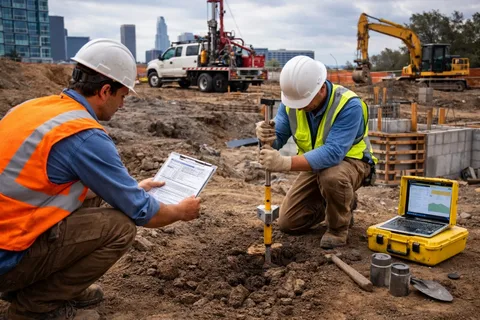
If you have managed a complex site work package recently, you already know the pattern. The geotechnical scope carries more risk than almost anything else in the ground, and the traditional design-bid-build structure often makes that risk harder to control. Plans get produced early, sometimes with limited subsurface information. Bids come in based on assumptions. Then the shovel hits the soil and the assumptions start to break down.
That is why more general contractors are shifting geotechnical scopes into a design-build delivery model. Specialty geotechnical construction delivered this way puts engineering and field execution under one contract, one team, and one point of accountability. For projects where ground conditions are uncertain, schedules are tight, or the structural loads are demanding, that alignment can be the difference between a clean excavation and a costly delay.
This article looks at why design-build is gaining traction in the geotechnical space, where it delivers the most value, and what general contractors should consider before structuring a geotechnical package this way.
Table of Contents
Why the Traditional Delivery Model Struggles on Geotechnical Work
Geotechnical work is different from most above-grade scopes. The product is largely invisible once it is installed. The conditions that drive the design are not fully known until you start digging. And the consequences of getting it wrong, whether that means slope failure, excessive settlement, or damage to adjacent structures, tend to be expensive and difficult to fix after the fact.
Under a traditional delivery model, the design is completed by one party, often a geotechnical consultant working for the owner, and the construction is bid out to a separate contractor. That separation creates predictable problems:
- The design is based on a limited boring program that may not represent actual conditions across the site.
- The contractor is incentivized to build exactly what is on the plans, even if a value-engineered alternative would perform better.
- Change orders and RFIs pile up when field conditions do not match the report.
- Responsibility for performance gets split between the designer and the builder, which makes resolution slower when something goes wrong.
None of this is a knock on consultants or on hard-bid contractors. It is simply a structural problem with the delivery model itself. When the party who designs the system is not the party who builds it, accountability and innovation both suffer.
What Design-Build Actually Changes
In a design-build geotechnical arrangement, the contractor holds both the engineering and the construction responsibility under a single contract. That single point of accountability changes how decisions get made throughout the project.
The design team is part of the same organization as the field crew. That means the engineers who develop the solution are working alongside the superintendents and operators who install it. Adjustments in the field do not require a separate change order cycle or a formal handoff. They get resolved quickly because the same team owns both sides.
For the general contractor, that structure delivers several practical advantages:
- Faster response to changing conditions. When the subsurface does not match the borings, the design can be modified in real time without waiting on an outside consultant.
- Better constructability. The people building the system have input into how it is designed, which reduces impractical details and improves installation efficiency.
- Clearer accountability. If a performance issue arises, there is one team to call instead of a designer and a contractor pointing at each other.
- More room for value engineering. A design-build contractor can propose alternative systems that meet performance requirements at a lower cost or faster schedule, because they control both the design and the means and methods.
Where Design-Build Delivers the Most Value
Design-build is not the right answer for every geotechnical scope. A simple retaining wall on a flat site with well-defined soils may not benefit much from the structure. But for certain project types, the model pays for itself.
Urban excavation support. Tight urban sites almost always involve surprises. Adjacent foundations, utilities, and mixed fill conditions show up once excavation begins. Design-build allows the shoring system to adapt as those conditions emerge, without stopping the job to rebid or redesign.
Slope stabilization and landslide repair. These projects are often driven by a failure that has already happened or a condition that is actively moving. The design has to respond to observed behavior, not just a static report. Design-build keeps the engineering and the installation tightly coupled so the solution can be tuned to actual performance.
Ground improvement on soft or variable soils. When you are treating weak soils to support heavy loads, the effectiveness of the improvement is verified through testing during installation. A design-build team can adjust spacing, depth, or method based on that test data without a contract restructuring.
Deep foundations under aggressive schedules. Drilled shafts, micropiles, and other deep foundation systems often interact with difficult ground. A team that owns both the design and the installation can sequence the work around the actual conditions and keep the critical path moving.
What GCs Should Consider Before Going Design-Build
Design-build is not a cure-all, and structuring it well requires some thought up front. Here are the questions that tend to matter most.
Is the scope clearly defined? Design-build works best when the performance requirements are well understood, even if the means and methods are not. If the project cannot define what the system needs to do, the design-build team will struggle to deliver.
Is there enough subsurface information to price the risk? A design-build contractor still needs reasonable geotechnical data to put together a credible proposal. A weak boring program shifts risk onto the contractor, which shows up in the price. Investing in a solid subsurface investigation up front usually pays for itself.
How will performance be verified? Because the design-build team owns the outcome, the contract should clearly define how performance is measured. That might include monitoring, load testing, or deflection criteria. Getting this right protects both parties.
Who holds the design license? In many jurisdictions, the design of a permanent earth retention or foundation system must be stamped by a licensed engineer. Make sure the design-build team has the in-house engineering capability to deliver that, or a clearly defined relationship with a licensed subconsultant.
How will changes be handled? One of the biggest advantages of design-build is flexibility, but that flexibility needs a contract structure that supports it. Work through the change process before the job starts so field adjustments do not become disputes.
A Practical Way to Think About It
A useful way to evaluate whether design-build makes sense on a given scope is to ask where the risk sits. If the risk is mostly in the installation, a hard-bid contractor with a solid design may be fine. If the risk is mostly in the unknowns, the interaction between design and construction, or the need to adapt as conditions emerge, design-build is usually the better fit.
For general contractors, the shift is worth paying attention to. Owners are increasingly asking for faster delivery, more predictable budgets, and cleaner accountability. The geotechnical scope, which has historically been a source of uncertainty on complex projects, is one of the areas where design-build can deliver all three.
The Takeaway
Design-build in the geotechnical space is not new, but it is expanding. More project teams are recognizing that splitting the design and the construction of high-risk ground work creates problems that a single accountable team can avoid. For general contractors managing complex sites, understanding when and how to use this delivery model is becoming a core competency, not a niche strategy.
If you are structuring your next project and the geotechnical scope carries real uncertainty, it is worth having the design-build conversation early. The right delivery model, chosen before the first shovel goes in the ground, can save time, reduce risk, and keep your project on track when conditions do not cooperate.